Local birds and wildlife
Discover the rich biodiversity of the Lower Trinity Valley. From coastal wetlands to bottomland hardwood forests in Liberty and Chambers counties, explore the best hotspots to identify native birds and experience our extraordinary local wildlife.
Great Texas Wildlife Trails
Great Texas Wildlife Trails
The Great Texas Wildlife Trails are a statewide network of self-guided driving loops created by Texas Parks and Wildlife to help travelers find some of the best wildlife-viewing sites across Texas. Each regional map highlights public access areas, refuges, parks, sanctuaries, nature centers, private sites open to visitors, scenic roads, and loop routes, with details that help birders and wildlife watchers plan where to stop.
The trails feature much more than birds, including butterflies, bats, pronghorns, alligators, prairie wildlife, coastal species, forest birds, and seasonal migrants. For birders, the maps are especially useful because they connect well-known hotspots with lesser-known local sites, making it easier to explore Texas by habitat, region, and season.


Great Texas Coastal Birding Trail - Upper Texas Coast
Great Texas Coastal Birding Trail—Upper Texas Coast
https://tpwd.texas.gov/huntwild/wildlife/wildlife-trails/utc
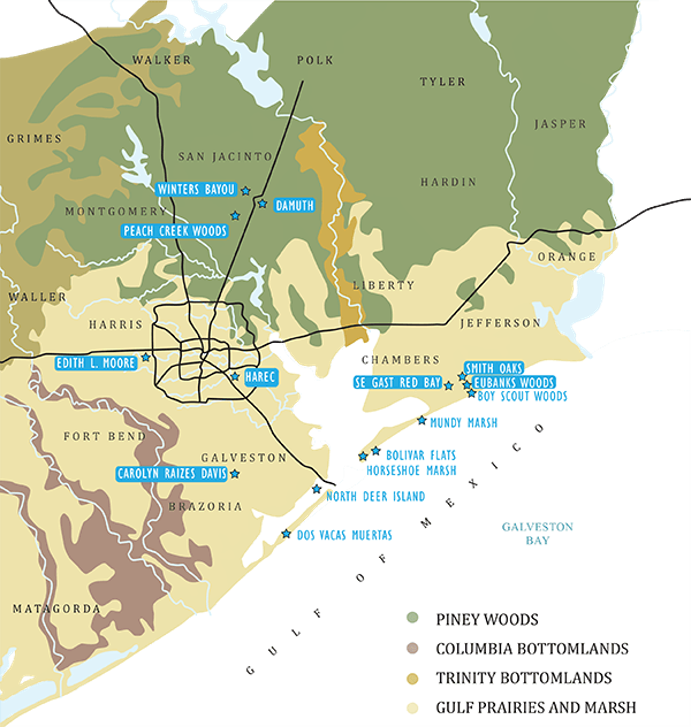
The Great Texas Coastal Birding Trail’s Upper Texas Coast section links some of the finest birding destinations from the Louisiana border through the Beaumont-Houston area and along the Gulf Coast to Galveston, High Island, Bolivar Peninsula, and the Brazosport area. Organized into driving loops such as the Big Thicket, Trinity, Anahuac, Bolivar, Galveston, and Katy Prairie loops, the trail guides birders through marshes, beaches, bay shorelines, rice fields, bottomland forests, rookeries, and urban nature preserves.
This variety of habitats makes the region outstanding for year-round birding, with herons, egrets, Roseate Spoonbills, shorebirds, waterfowl, raptors, woodland species, and spring and fall migrants all possible along the route Below are our nearest loops:
Birds Houston
Birds Houston owns and manages 18 nature sanctuaries totaling 4,307 acres, most of which are open to the public.
Birds Houston’s refuge at High Island and Bolivar Flats offer world-class birding within an hour’s drive of Mont Belvieu.
- High Island https://ebird.org/hotspot/L128987
- Bolivar Flats Shorebird Sanctuary https://ebird.org/hotspot/L128987


Birding in Liberty and Chambers Counties
From modest beginnings, we've grown through unwavering dedication and a commitment to continuous improvement. Each step has reinforced our core belief in the power of collaboration and the importance of integrity. We're passionate about what we do, and we're excited to share our story with you. Liberty County, Texas
https://ebird.org/region/US-TX-291/bird-list
Liberty County offers excellent inland birding where the Trinity River floodplain, bottomland hardwood forest, cypress sloughs, oxbow lakes, rice fields, and piney woods meet. Key spots include Trinity River National Wildlife Refuge, Champion Lake Public Use Area, Liberty Municipal Park, Knobby Knees Trail, and Liberty-Dayton bridge area, and the Menard Creek and Loblolly units of Big Thicket National Preserve.
Birders can look for Wood Ducks, herons, egrets, ibis, Anhinga, woodpeckers, Barred Owl, Red-shouldered Hawk, Swallow-tailed Kite, Bald Eagle, Prothonotary Warbler, Northern Parula, White-eyed Vireo, Painted Bunting, and many spring and fall migrants. Because many sites are low and wet, visitors should check access conditions, bring insect repellent and water, and be prepared for muddy trails, flooding, and occasional alligators near wetlands.

Champion Lake Public Use Area
Champion Lake, nestled within the Trinity River National Wildlife Refuge, offers exceptional birding across scenic cypress sloughs and open waters. Visitors can regularly encounter wood ducks, prothonotary warblers, swallow-tailed kites, anhingas, and wading herons throughout the seasons.
https://ebird.org/hotspot/L330858
Champion Lake Public Use Area in Trinity River National Wildlife Refuge is a strong birding destination because it sits within protected bottomland hardwood forest, wetland, lake, and bayou habitat along the Trinity River. Birders can scan open water and marsh edges for Wood Ducks, herons, egrets, ibis, Anhinga, Belted Kingfisher, Osprey, Bald Eagle, and other water-associated birds, then listen along wooded trails and edges for woodpeckers, vireos, wrens, warblers, and other migratory songbirds.
Summer nesting Prothonotary. Northern Parula Warblers and White-eye Vireos are common. The refuge is especially valuable during spring and fall migration, when colorful neotropical migrants move through the Trinity River corridor, while winter can bring waterfowl and raptors.
Visitors should check refuge conditions before going because flooding and seasonal hunting closures can affect access, and should bring binoculars, water, insect repellent, and caution around alligators and other wetland wildlife.

J.J. Mayes Wildlife Trace and river trails
Located on the banks of the Trinity River in Chambers County, the J.J. Mayes Wildlife Trace provides accessible walking trails, boardwalks, and observation points. It is a premier location to spot roseate spoonbills, yellow-crowned night-herons, seasonal flycatchers, and American alligators basking in the sun.
https://ebird.org/hotspot/L276755
JJ Mayes Wildlife Trace, part of the Wallisville Lake Project near the Trinity River, is a rewarding stop for birders because it combines marsh, riverbank, bottomland forest, and wetland habitats in one easy-to-explore area. Visitors can bird from the all-weather levee road, walk boardwalks and trails, or pause at overlooks to scan for herons, egrets, ibis, Roseate Spoonbills, cormorants, rails, ducks, raptors, and migrating songbirds.
It’s quiet setting, mix of open water and wooded edges, and location within the Upper Texas Coast migration corridor make it especially productive during spring and fall migration, while winter can bring waterfowl, Osprey, and Bald Eagles. Birders should bring binoculars, insect protection, and watch carefully for alligators and other wildlife along the marsh edges.

Birding Chambers County
Chambers County, Texas
https://ebird.org/region/US-TX-071
Chambers County is one of the best birding areas on the Upper Texas Coast because it blends coastal marsh, rice fields, bay shoreline, oak mottes, wet prairie, bayous, and bottomland forest within a major migration corridor. Productive stops include Anahuac National Wildlife Refuge, the Anahuac Loop of the Great Texas Coastal Birding Trail, White Memorial Park, Fort Anahuac Park, Double Bayou Park, Smith Point, the Wallisville Lake Project, JJ Mayes Wildlife Trace, and nearby High Island sanctuaries.
In winter, birders can look for ducks, geese, raptors, sparrows, and cranes, while spring and fall migration bring warblers, vireos, tanagers, orioles, shorebirds, swallows, and other Gulf Coast migrants. The variety of habitats makes Chambers County rewarding for both casual birdwatchers and serious.